

Alex Vigneault
Associate
Contact Information
(705) 722-4400 ext. 224 avigneault@chcbarristers.comAssistant: Nicole Staniewski
(705) 722-4400 ext. 223 nstaniewski@chcbarristers.comLaw Clerk: Andrea Lummis
(705) 722-4400 ext. 234 alummis@chcbarristers.comBaker Decision
Termination clauses in employment contracts are consistently one of the most debated and contentious aspects of Ontario employment law, largely for one main reason: a strong, court-upheld termination clause can limit an employee’s entitlement to notice (or pay in lieu of) to the minimums prescribed by the Employment Standards Act (“ESA”), where they may have otherwise been entitled to much, much more under common law.
Nearly identical clauses have been struck down in one case and upheld in the next, often on the strength of a single word. In Baker v. Van Dolder’s Home Team Inc., 2026 ONCA 568, the Court of Appeal for Ontario set out to restore some predictability.
The Decision
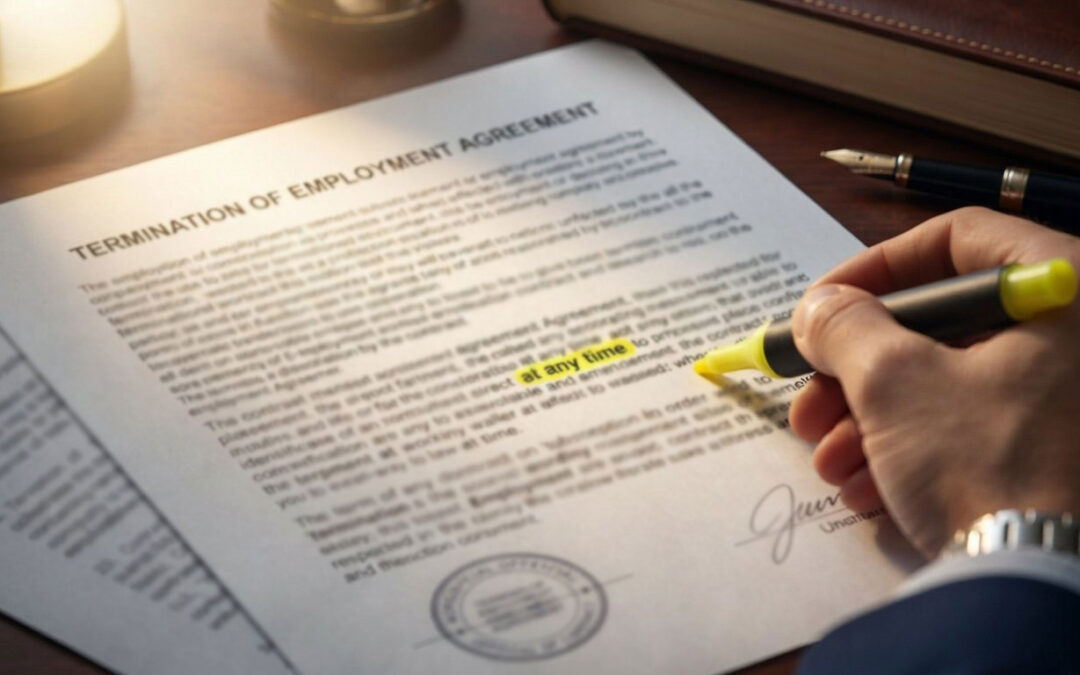
The Court heard two appeals together. In Baker, a finance executive dismissed without cause argued his termination clause was void because it let his employer terminate “at any time” – wording a lower court had found to be inconsistent with the ESA. In Li v. Wayfair, a senior product manager attacked a clause permitting termination “at any time and for any reason.” One motion judge struck the clause, while the other upheld nearly identical language. The Ontario Court of Appeal was tasked with sorting out this inconsistency.
The Court of Appeal upheld both clauses, holding that employment contracts must be read as a whole, in light of the parties’ objective intention – not by isolating individual phrases. “At any time”, the Court said, simply means a without-cause termination is valid whenever it occurs. It doesn’t necessarily signal an intention to dismiss someone in circumstances the ESA prohibits, such as reprisal or during a protected leave. “For any reason” merely means the employer need not provide a reason.
The Court also upheld a “with cause” clause – but only because it expressly preserved the employee’s minimum ESA entitlements. That distinguished it from decisions like Dufault, which struck down clauses denying all compensation for misconduct that falls short of the ESA’s demanding “wilful misconduct” standard.
Why This Matters
Baker is a decisive move away from the approach that has dominated recent case law, where termination provisions were scrutinized in fine, technical detail. Employers have a clearer path to drafting termination clauses that will actually hold up and limit their exposure to ESA minimums.
All of the above said, Waksdale still governs: if any part of a termination scheme breaches the ESA, the entire scheme falls with it, and clauses that strip employees of their statutory floor remain void.
Whether you are an employer who wants agreements that survive a challenge, or an employee who has been handed a package and told “this is all you’re entitled to,” that distinction can be worth many months’ pay. Our employment law team can review your contract and tell you where you truly stand.
This article is general information, not legal advice, and does not create a solicitor-client relationship. For advice on your specific situation, please contact us.
Recent Comments